Wednesday, 28 August 2013

Syria: Why now, Why us and What next

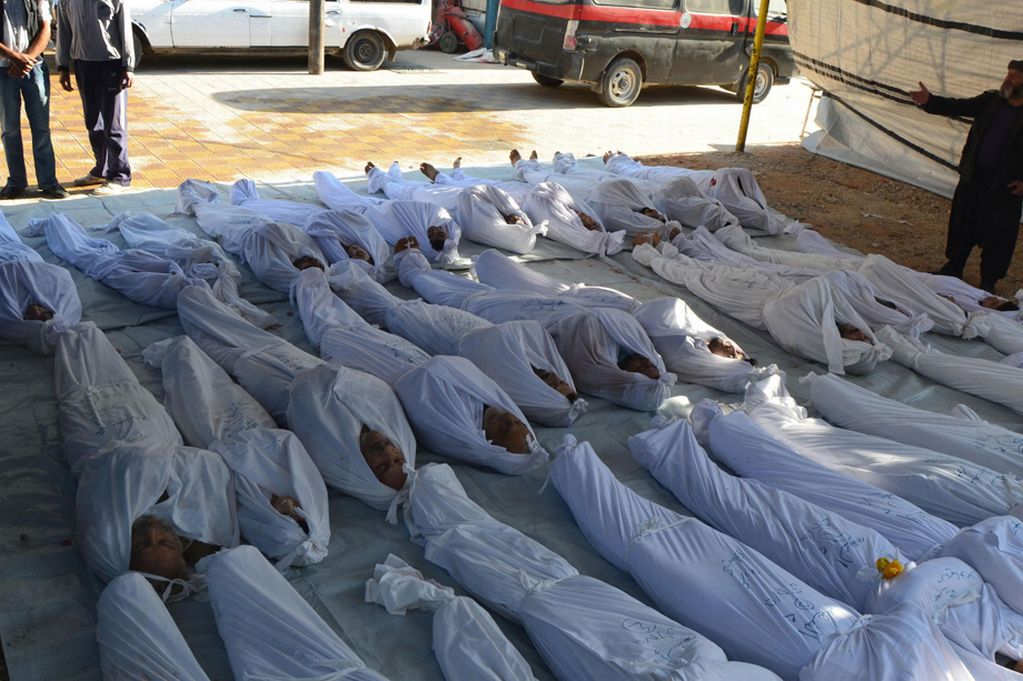
We are about to go to war with Syria. That means many innocent people will die, be maimed and displaced. I think three key questions remain unanswered, and fear we are about to do entirely the wrong thing.

Instead of firing missiles, the Damascus gas attack could instead be used as a catalyst for meaningful peace talks.


Why now

We live in a YouTube world. Earlier this year I was sent a clip that journalists reporting on the Syrian conflict were posting to each other. It was of a young man who had had his jaw and the lower part of his face blown off by shrapnel from a missile strike. He was fully conscious and well aware of what had happened to him. As others ran shouting around him, he sat on his gurney bolt upright and could only half shout half groan, with what was left. 

It is impossible to comprehend the mental and physical agony that that young man was in at that time. He was from Daraa where the conflict first erupted, and a quick web search reveals he died some days later.

I give this utterly horrific example to ask my first key question: why now? The answer we're given is that chemical weapons have been used for the first time and that that represents a line that humanity simply cannot allow to pass. But as commentators elsewhere have observed, that line was crossed months ago already (contrary to what William Hague claimed this afternoon) and as horrendous as the deaths of hundreds of innocent people from poison gas quite clearly is, can anyone explain to me why the suffering of the young man from Daraa is any less horrendous, even if it wasn’t as a result of gas? 

The answer seems to be a determination by the UK, US and France to diplomatically outwit Russia and China by using the shock effect of the Damascus attack to break the logjam that has repeatedly paralysed the Security Council at the UN. So its more about high politics than high principles, which is presumably why even Ban Ki-Moon has responded to today’s UK tabled resolution with the argument that it is too early and that the inspectors need four more days to complete their work.Why not use the pressure on Russia and China to have a meaningful conversation about how to bring the warring parties to the table instead of bypassing them in a rush to ... well what, exactly?

Why us

As journalists breathlessly produce graphics highlighting the locations of UK, US and French warships, complete with flags, the images take me back to A level history classes when we learned about gunboatdiplomacy. This was the tactic of choice for the colonial powers in the Middle East and North Africa and it appears we are about to return to our nineteenth century roots.  The point of this observation is that it de-legitimises the forces we claim to support, even if we don’t actually understand who they are.

Another answer we are given to this question is the Responsibility to Protect, or R2P. This mandates the international community to intervene in order to protect civilians from harm, including from their own governments. But as Sir John Holmes, former head of the United Nations Office for the Co-ordination of Humanitarian Affairs argues, it is far from clear how firing missiles from submarines is set to achieve this, and is likely to make aid workers targets themselves. 

What next 

The big question to which nobody – including those leading the calls for military action - has an answer. Any answer at all. Lord West, a former First Sea Lord of the British military today asked pointedly: "You can do a surgical strike but you need to be clear what is your whole campaign plan, where do you go from there?". He went on to point out that you cannot simply drop a few missiles and then withdraw – you have joined a war, with all that that entails. And as Dan Smith in his blog points out, mission creep happens as sure as casualties follow bombing campaigns.

It seems to me that without a clear answer to any of those questions  now is not the time to act, and using missiles is not the right tactic. In the words of Ban Ki-Moon earlier today, it is perhaps still time to give peace a chance. 

Monday, 22 July 2013

ODI goes retro: negative peace

“…you, the said Galileo... have rendered yourself vehemently suspected by this Holy Office of heresy, that is, of having believed and held the doctrine (which is false and contrary to the Holy and Divine Scriptures) that the sun is the centre of the world, and that it does not move from east to west, and that the earth does move, and is not the centre of the world."
Father Vincenzo Maculano da Firenzuola, June 22nd 1633, at the trial of Galileo Galilei.

Every now and again something comes along that proves people haven’t really moved all that further forward in responding to inconvenient truths with knee jerk and perverse conclusions. One such example was the recent paper on post-2015 by the otherwise excellent Overseas Development Institute (ODI). 

This paper by Lisa Denney is a response to the call by the High Level Panel to establish a stand alone goal on peace and conflict in the post 2015 development agenda. It seems to argue that, since there is little evidence of good governance leading to economic progress, the drafters of a new development agenda shouldn’t bother with it. Instead, they should concentrate on the absence of actual violence rather than anything like human rights, participatory politics, accountability or transparency as indicators of progress. There just isn’t the evidence, she argues, to justify all that rights and governance stuff. So as long as people aren’t actually being killed, we might still eradicate poverty.

Deep breaths.

It’s difficult to know where to start with an argument like that, which is perhaps why I went for the Holy Roman Empire. But let’s just take Ms Denney’s arguments in sequence.

The paper essentially argues that we have lots of evidence of how violence can disrupt development, and quotes Collier’s famous “30 years of GDP lost” in support. So we know, then, that the absence of violence is good for economic growth. But it goes on to say that there is not the same evidence illustrating how the existence of good governance – for example democracy, freedom from repression, accountability and human rights – actively contributes to that economic growth. Thus, the author claims, we must prioritise “negative peace” (the absence of violence) over “positive peace” (not just the absence of violence but the active involvement and rights of people). Denney argues:
“…there does not appear to be sufficient evidence to argue that anything beyond a ‘negative peace’ approach is actually instrumental to other developmental outcomes”.
and goes on to claim that 
“there is stronger evidence for linking insecurity and poverty than peace and development … therefore while some might suggest that peace enables development, it is empirically more accurate to say that conflict or insecurity disrupts development”
Three points in response: what is development, why is there a lack of evidence and what does this conclusion mean.

What is development?


Denney spends a lot of time in the first part of her paper deconstructing terminology and vocabulary, which is fair enough given the amount of jargon floating around in these debates. But the one word that is left alone is probably the most important: development. It is clear throughout this paper that Denney conceives of development as being solely about economic growth rather than, for example, political institutions. So with such a narrow definition of development it becomes possible to make the case she does. Or does it? What sort of economic growth are we talking about? 72% of the world’s poorest people live in Middle Income Countries. In other words even when you have economic growth as measured by GDP you do not necessarily achieve equitable economic growth and, thus, the majority of people remain poor. And, in situations where violence is routinely used by elites, very vulnerable. Without a politically engaged and aware population, who are able to hold their governments to account through robust political institutions, that situation will not change any time soon and the glaring inequalities it creates and perpetuates will contribute directly to the potential for violence. Which will disrupt growth. Now how much “development” have you achieved? One of the reasons the World Development Report of 2011 linked jobs, security and justice was for precisely this reason – development is political as much as economic, and to pretend otherwise is a recipe for repeating the errors the report was concerned with, which has left over 1.5 billion people in conflict affected states as poor and vulnerable as they ever were at the outset of the MDG era.

Consider too that a post-conflict state is also, statistically speaking, a pre-conflict state with the majority of wars being recurrences of old. To achieve any kind of growth at all you need to break that cycle.. Here’s the World Development Report:
“…strengthening legitimate institutions and governance to provide citizen security, justice and jobs is crucial to break cycles of violence.”
Even the IMF, the bastion of econometrics, in a report released in January this year recommended, based on a study of 146 civil conflicts:
"...a strategy for reconciliation and recovery centered on three main pillars—implementing growth enhancing policies, reforming dysfunctional institutions, and addressing urgent social needs— to reduce the risk of conflict recurrence."
And here's Mthuli Ncube, Chief Economist and Vice President of the African Development Bank:
"Deliberate policies to reduce inequalities and promote inclusion are now needed more than ever before. It is time to focus on people’s expectations: decent work, a living wage, access to basic service, more democracy, and accountable governments...Governance is now one of the cornerstones of economic development. Good governance, in its political, social, and economic dimensions, underpins sustainable human development and the reduction of poverty, in that it defines the processes and structures that guide political and socio-economic relationships"
In other words, 'growth enhancing policies' will only work in these situations if combined with political development too. Denney’s argument, if taken up by the OWG, risks perpetuating violence and undermining progress by ignoring the role of political institutions, 'urgent social needs' and accountable governance. 

Why the lack of evidence?


Denney claims that while there is a wealth of evidence highlighting the causality of violence and a lack of growth there is not an equivalent amount linking positive peace with that growth. She is of course completely right: because it hasn’t been tried yet. Is it any wonder after nearly 15 years of the whole world pumping vast resources into an MDG inspired focus on economic and technical indicators that we now have a wealth of evidence about how violence is an inhibitor? No, not particularly. Is it any surprise that, given there has not been an equivalent scale global push to establish and pursue the elements of positive peace – where people have the right to participate in the running of their own countries without fear or repression – that there is not a wealth of evidence of what works and what doesn’t? Well, guess what folks, no. To use the lack of equivalent evidence for something you haven't tried yet as the basis to do nothing new is both retrograde and reductionist in the extreme.

What does this mean?

So what does Denney’s conclusion that ‘negative peace’, simply the absence of a body count, be prioritised over the rights of people to play a full role in their countries mean? To be fair to Denney she states:
“The arguments made here should not be construed as being ‘anti peace'”. 
That’s good, but hang on a minute, she continues:
“…of course living in open and accountable societies is more desirable to many people … [but] … there are endless ‘goods’ that we could include in the post-2015, [sic] … it is important to make decisions about the key priorities, given that the ultimate focus is on eradicating extreme poverty…[and]… the stronger correlations between insecurity and poverty than between peace and development suggest that our efforts should be focussed on a negative peace approach. That is what we know is most likely to have the greatest dividend for reducing poverty.”
This is a pernicious argument. I don’t claim it is made with malign intent but the effect is sinister. Quite apart from it being disturbing for a comfortable Western research institute to casually dismiss the hopes of the poorest to have the fundamental rights we enjoy in a cast off comment; “..there are endless ‘goods’ we could include..”, - the more dangerous implication of her argument is that we should carry on as usual, seeing ‘development’ as purely economic and people’s rights as nice-to-haves rather than must-haves. Music to the ears of strongmen everywhere.

To make this case also requires you to ignore recorded human history. The richest countries in the world achieved that status not through a focus solely on a set of economic goals but through centuries of contested political ideas in which groups of people fought for rights, and elites sought to deny them. The context in which they did that might have been economic: for example the industrial revolution, but the battles themselves were about power and politics. What emerged in the West were constitutional democracies, within which that economic growth and the emergence of the rule of law took place. And that is precisely the aims of those living in the states most affected by the absence either of good governance or economic progress and scarred by endemic violence, as can be seen by the New Deal for Engagement in Fragile States. Far from perfect, the New Deal nevertheless for the first time redefines ‘development’ as being as much about a participatory journey towards growth, between State and citizen, as well as a partnership of equals between donor and recipient.

The clue to the New Deal lies in the name. It is new. The evidence of what works doing things this way is scarce precisely because it hasn’t been tried systematically or on a global scale before. The ODI know this, yet still argue for a reductionist approach which disregards the elements of a broader vision of human development including peace, justice and human rights which have emerged as the central themes not only of the New Deal but of the global civil society response to the High Level Panel, leading them to call for a specific peace and justice goal in the post-2015 framework in those terms.

You have to ask why the ODI don't agree. 

Sunday, 2 June 2013

Post 2015: Development redefined, but can we adjust?


Baton is passed
The High Level Panel report on the post 2015 development agenda has redefined development and placed the most difficult issues, that have robbed the poorest and most vulnerable from sharing in the progress enjoyed by some since the MDGs were first unveiled, centre stage.

We know that 1.5 billion people live in countries that have made the least, if any, progress toward the technical milestones of progress represented by the MDGs. Just stop to think for a moment about that number. 1.5 billion out of a global population of just over 7 billion.

The reason for this was that world leaders at the time simply avoided one of the most obvious reasons for extreme poverty in front of them – bad or non-existent governance and resource capture by rapacious elites, in many places – and opted for global measures that would allow them to maintain the pretence that you could somehow end poverty by massive financial transfers, in many cases to those same elites, while concentrating solely on technical projects that had nothing to do with the political factors lying at the heart of so much human misery. Vested interests, from donors and recipient governments, as well as the aid industry itself, won out. Progress, in some cases amazing progress, was nonetheless reserved exclusively for people living in areas that were already relatively stable.

The Panel have identified five “transformational shifts” to deliver radical change in pursuit of the goal to end extreme poverty by 2030. One of those is peace and security, both as an inalienable human right to which all should be entitled but also as a basic pre-requisite to growth. Sounds simple, and many have been saying it for years, but it’s going to mean some fundamental change – both for governments and the aid industry itself.

High Level Panel
Gone is the certainty of only responding to violence in a way that picks up the pieces, such as services for victims of sexual violence. In is the approach that also sees the active political participation of those communities – including women, the young and people with disabilities – as a non-negotiable part of the deal. Superb. And we have some of the more progressive voices from within the Panel, which inevitably had internal differences, to thank for it. Here’s Sweden’s Foreign Minister Gunilla Carlsson on the thinking behind it:
"We have had frank debates, and I have chosen to focus on areas that often encounter resistance around the world. I am therefore pleased that the panel was finally able to agree on strong language on, for example, political freedom, freedom from corruption and the importance of sexual and reproductive rights. It's a great victory, certainly for Sweden, but above all for people around the world living in poverty and exclusion…"
Not sure about the ‘victory for Sweden’ language, there, but you get the picture. Ms Carlsson was one of the stars of the Panel for me, diplomatically but very firmly rejecting the idea of some of her colleagues that all we needed to do was roll over the MDGs.

So what does this new world of political inclusion and active citizenship look like? Highlights from the report include:
  • More jobs and equitable growth
  • Improved political governance and effective institutions
  • Stable and peaceful societies
  • Sustainable management of natural resources
So in other words growth in which everyone can participate and freedom from violence tackled by giving people a say in the governance of their countries and communities. The logic was quite nicely summed up by Owen Barder in his weekend blog entitled “it’s the politics, stupid”.


No single lobby got everything they wanted out of this process. They were never going to. And it was clear from the two hour lobby-fest that the Panel were subjected to by the 200 or so lobbyists that took part in the London meeting that there were going to be some upset people. Oxfam, for example, is upset that there was no goal on inequality.

And while this may look like a paradigm shift from a peace and conflict perspective, which it is, for me the relegation of the New Deal for Engagement on Fragile States to the status of an annexe at the back of the report is baffling, particularly since its implementation represents much of this new agenda in action, right now. During the Africa consultation of the UN Task Team on Post 2015’s Global Consultation on Conflict, Fragility and Disaster President Johnson-Sirleaf dropped in for what I will never forget was called a “Fragility Dinner” (yes, really) – the first thing she asked the UNDP bods was “where is the New Deal” and the last thing she asked them was, er, “where is the New Deal”. Well, it doesn’t seem to be anywhere in the report that she helped co-chair, much.

Ellen Johnson-Sirleaf at the "Fragility Dinner": Where's the New Deal?
 So there will be obstacles. And they will come very soon and at times appear insurmountable. But while most people’s understanding of that is the power politics and inter-governmental negotiations that will now take place within the Open Working Group my own sense is that global civil society itself now needs to significantly up its game and, in some cases, work in very different ways.

I have been told by several officials closely involved with the High Level Panel, from a number of countries, that their greatest fear is that the momentum of this report is somehow lost or diluted. And that fear is well placed. Those elites in 2000 that opposed any reference to peace, security or political participation to the last set of MDGs are in many cases still there. And some of the newly powerful actors in global governance are at best ambivalent about the ideas. 

So what should we do? In my view, for what it is worth, we need to think about legitimacy, organisation and ideas.


Legitimacy

The Open Working Group is a strange name for a group where the main business will be conducted, in classic UN style, behind closed doors. The meetings will not be where the action is at. It will be, to a large degree, a closed working group. In fact one senior official who will be representing their country at some of these negotiations told me that it is already known as the “open wound group” which at least shows that there is a good sense of dark humour among some of them!

Civil society needs to shine a consistent light on how the group is working, and the activities of its members between now and the conclusion of its work.

This will be actively welcomed by some, and very much resisted and resented by others. It may be that some civil society groups are actively intimidated by their own governments from speaking out. How is global civil society going to support them? One way, it strikes me, is through making information available using new technologies and old, in the way that the MyWorld consultation has apparently managed to do with a great deal of success. If MyWorld, as imperfect as it is, manages to generate a sustained public involvement in the debate which is demonstrably coming from the ground up, even the hardest nosed negotiators will find it hard to justify ignoring them.

Organisation

The Beyond2015 coalition has been more effective than many of us I think expected it to be. Civil society recognised that we needed a platform and formed one. But networks need to be maintained and kept active, and what concerns me at present is that while the High Level Panel along with the UN Task Team events led to literally hundreds of opportunities around which civil society could interact and mobilise there is no obvious means by which the Open Working Group provides the same level of engagement. How do you interact, for example, if you are a grassroots organisation in a country who’s government is not even a member of the Open Working Group? The coalition will need to find a way to facilitate that active discourse.

Globally, despite all our disappointments at various elements of the report, we will need to recognise that this is the best chance we have to achieve a vision of development that actually works for everyone. And that will mean coming together and getting behind it in a co-ordinated way. 


Ideas

We are in a new phase of global governance. New powers have risen as have new coalitions among them. The High Level Panel consisted of classic representatives of governments, but it also included a human rights activist and CEO of a global corporation. The Panel identified civil society, youth and business as their core constituencies with which to engage and the report is clear that the private sector, for example, has a key role to play.

I do worry, then, when I hear perfectly legitimate complaints about tax avoidance appearing to spill over sometimes into an anti business approach by some. I have been at numerous discussions in the last months at which “business” has been spoken about as if they are the enemy and a threat. They are not. In fact at local level they are often the same people who take huge risks to bring peace to their communities, while developing opportunities for people to pursue their own ambitions and provide for their families.

So just as governments will need to adjust to a new way of doing business, some of the old ideology of the aid industry may also need to change. The reality is that we all need checks and balances, business, government and us included, but we are all part of the solution.

Interesting times ahead.

Friday, 10 May 2013

MEPs size up BRICs: but who are they both?


In a typically impenetrable EU document, meant as a press release but written more like an insurance policy, the European Parliament has given an insight into how it regards the emerging BRIC bloc as a potential foreign policy actor. The question seems to be “are they partners, or rivals … and who are they anyway?" while their very long answer seems to go to the heart of who or what the EU should be as a global foreign policy power for the next decade which makes it quite interesting as Europe starts to consider who should replace the High Representative for Foreign Affairs, who has announced she will be stepping down next year.

The EU has a foreign policy?

The EU’s own evolution as a foreign policy actor is frequently talked about from a negative starting point. There are, after all, no shortage of examples from Yugoslavia, the on-going games of nuclear footsie with the Iranians and a failure to predict or respond to the Arab Spring to illustrate its weaknesses.

Yet the recent Serbia-Kosovo accord, for which High Representative Cathy Ashton was rightly lauded, is not easily dismissed and suggests that when the EU plays to its strengths then breakthroughs in the most irreconcilable situations can become possible.

What’s the big picture?

Foreign policy analysts tend to look at the EU’s evolution from three perspectives. A realism perspective holds that this is all about balancing: pure power politics in this case aimed at giving Europe enough weight to push back against the dominant US. Liberal theorists think this is an outdated view and suggest that it is instead a collaborationist venture with partnership and trade at its core. While normative thinkers bewail the EU’s abandonment of its original aim of being a civilian power, projecting values instead of soldiers, and suggest that this is all now part of a journey towards supranational statehood with the acquisition of accoutrements of statehood along the way, such as the Common Security & Defence Policy.

Whichever is closer to the truth probably depends on who you ask, but the emergence of an alternative power, trading or value system in the form of the BRICs is a direct challenge to any and all of those agendas, so no surprise that the European Parliament has been giving it some thought.

Martin Schulz
Why should we care what the Parliament thinks?

The European Parliament has long been a paper tiger, with MEPs unable to exert any influence between the two extremes of a) nothing and b) Armageddon. The Armageddon option has only been used once, triggering the resignation of the entire Commission, so they rarely present a major challenge to Berlaymont.

So who cares, you might ask.

The answer is that in recent years the Parliament has grown in bargaining power vis the other three elements of the EU – the executive arm of the Commission, the Member State Council and the European Court. This can be observed by the likelihood that the budget recently agreed by the Council and Commission will be rejected by the Parliament and be re-negotiated, while the current President of the Parliament Martin Schulz is widely regarded as the incoming President of the Commission.

Put that power next to the forthcoming 18 months of jockeying for position to replace Cathy Ashton as the next High Representative, and you have a Parliament entering and shaping the debate about what that replacement should actually be doing. In other words, what is the role of the EU as an actor on the global stage for the next decade? So they matter, for once.

Altogether now
What do they think of the BRICS, then?

It makes interesting reading. If you separate out some of the ridiculous demands, such as the Parliament should be represented in bilateral meetings between the EU and BRIC countries (what other foreign ministry would do that?) and the mundane, then you have some very pertinent observations that are worth dwelling on. There are too many to list exhaustively, but three stand out for me.

First, the BRICS are not a coherent group. The MEPs note:
“major differences characterise them in political, economic and social terms; … in particular, that their political systems vary from strong authoritarian regimes to credible and stable democracies; [and calls on] the EU to step up relations and develop synergies, in particular, with those BRICS that genuinely share and respect democratic values and strive for a social market economy.”
So, roughly translates as develop relations with India and Brazil, while taking Russia and China to task over civil liberties. Big ask.

Secondly, the EU’s power is not on the wane in the new multi-polar world, represented by the rise of the BRICs, or “emerging powers”:
“…with the emergence of new economic and foreign policy powers, the EU will not see its leverage reduced but has an important role to play in promoting a common understanding on policy choices and should show leadership in tackling global challenges; … the EU and its transatlantic partners should focus on achieving the necessary economies of scale and develop concerted efforts to enable them to interact with the emerging powers constructively and effectively both in a bilateral and multilateral fashion, and in a spirit of true partnership and good cooperation; [there is a] need to develop an inclusive system of global governance, based on cooperation and coordination with the BRICS and other emerging countries, as appropriate, for the benefit of all; [which] points further to the key role of the EU and its transatlantic partners in promoting an inclusive system of global governance; [and] that the EU should act more strategically so as to bring Europe's true weight to bear internationally, in particular by managing the implications of interdependence, instigating reforms of global governance, and mobilising collective action in areas such as the rule of law, sustainable environment and regional security, through constructive interaction with the BRICS and other emerging powers”
Bit of a long one that but I thought it worth quoting in full – they seem, in classic liberal terms, to be calling for a new world order based on collaboration (note “with our transatlantic colleagues” interestingly, no realist balancing of the US here), free trade and the rule of law. Not a bad goal, if a little lofty.

And thirdly, despite all this new world order stuff, we’d quite like global governance to pretty much stay as it is, please:
"[The Parliament] believes that the current sovereign debt crisis will be an important test for the G-20 as an effective forum for strategic political dialogue able to promote a truly global system of economic and financial governance reflecting the interdependence between developed economies and emerging ones, creating the foundations for the elimination of systemic unbalances which can be particularly damaging both for developed economies and, in a longer-term perspective, emerging ones, and promoting solidarity in international financial fora such as the International Monetary Fund”
Ignoring the fact that the G20 does not include many nations who would, both by population size and GDP, surely equal those who are members (such as Indonesia) the Parliament is here calling for things to stay as they are. Indeed the reference to the IMF is also interesting – especially since the Director is always European, by tradition. So no great difficulty working out what’s going on there.

So what do they want?

Looking at these three it seems the Parliament want a) to be at the negotiating table, b) a bit of new world order based on liberal trade and c) for the EU’s foreign policy goal to be to defend Europe’s grip on at least some of the levers of global governance. A cocktail of liberal free trade with a dash of power politics.

Will they get it? Doubtful, but as a contribution to the debate over how Europe's role as a global foreign policy actor in the next decade, it’s not a bad starter. 

Tuesday, 23 April 2013

New Deal Postscript: Time for action


Last week I wrote about real concerns over the future of the New Deal for Engagement in Fragile States, ahead of a meeting on the fringes of the World Bank’s Spring Meetings in Washington. It seemed as if despite best intentions, innovative thinking and early momentum old habits were creeping back in to even this new model of doing development.

On the ground relations between local civil society and their national governments were being stymied while meetings were increasingly being dominated by power politics, rather than collective visioning of a better future which dealt with the complex drivers of conflict and instability. Despite this, we were still seeing a series of communiques and declarations proclaiming the bright new future that the New Deal was delivering; it had begun to look like nobody could spot the elephant in the room.

So, how did they do in DC?

Well they have a sense of humour these policy elites, as I understand the room was informed that the communique was final, not for debate and could we all applaud it please. A ripple of polite acclamation ensued as eager eyes scanned the detail, haggled over behind closed doors hours earlier. 

It was, as ever, a compromise and probably the best they could do. It clings to the idea that the New Deal has already been transformative:
“the New Deal has had significant impact in influencing the discourse and policies of international and national partners, at both global and at country levels”
But introduces a welcome note of humility:
“The initial progress and results achieved in the implementation of the New Deal in a number of self-nominated pilot countries give grounds for optimism and provide the basis for increased efforts”.
Grounds for optimism. I can live with that. But then it gets a bit better:
“We now urge g7+ governments, bilateral and multilateral development partners, civil society, and the broader international community to step up their efforts to translate New Deal commitments into concrete changes in behaviour and practice, in support to country-owned and country-led priorities, and consistent with national law and internationally agreed principles”.
Note concrete changes changes required – not delivered – required. And:
“Development partners are encouraged to implement policy and operational reforms to align with the New Deal, in particular the TRUST commitments. Efforts to manage risks, increase the use of country systems - with appropriate financial management in place and consistent with national laws and internationally agreed principles - and to support the building of national capacities, including of civil society, for example, should be enhanced”.
Not perfect, but attention to building civil society capacity also good.

Much of this was not in the original draft communique, and reflects the fact that some of the hard truths told to power at this meeting were at least heard and reflected upon. Attention to actually changing policies and practices, and embedding local consultation with communities in the business of development and governance, receives a welcome shot in the arm.

So the meeting seems to have made a positive contribution. But a communique is only ever a communique. And the acid test for the New Deal, surely, is what now happens on the ground, particularly in those countries currently piloting its implementation.

Civil society, at national and international level, has a vital role to play in monitoring and assisting that process, with governments and donors held to account for what they do next. A positive focus on that, rather than shouting about what we don’t like in the latest communique might be the most productive strategy to follow.

There’s a lot riding on how the New Deal works in practice, and not only for the G7+, or other countries nominally classed as “fragile”. Experience since 2000 teaches that building participatory relationships between communities and those that seek to govern them goes to the heart of whether development itself works; get that wrong, and the poorest stay poor while the vulnerable remain so.

Get that right, on the other hand, not just in rhetoric but in reality, in the run up to 2015 and we might be looking at a fundamental and positive re-casting of international development itself as the rest of the world takes notice.

High stakes indeed.

Wednesday, 17 April 2013

Global elite address conflict


Heads will be collectively scratched in Washington on Friday at a mystery. Why do the world's elites not spot an emperor with no clothes on?

As the great and the good gather for the Spring Meetings of the World Bank they will also be mulling over what the international development agenda could or should look like after the expiry of the Millenium Development Goals (MDGs). They are not short of ideas, as we saw in London when the High Level Panel of Eminent Persons established by the UN Secretary General were subjected to a two hour mass lobby.

Tony Blair recently said "to decide is to divide" and there is no doubting the difficulty of making the priority call on a long list of vital issues to include in the next global set of targets to measure how the world is doing by its most vulnerable and poorest citizens.

Yet there is one subject, almost uniquely, that both the elite and the development lobby agree on: we have to do something about conflict. A quick look at the MDG league table reveals the stark reality that the poorest and most vulnerable have been left behind by the old way of doing things, with no conflict affected country set to meet a single MDG.

It's not difficult to see why. Conflict is political but the MDGs are technical. Conflict takes generations to tackle, but the MDGs set a 15 year deadline. In short conflict goes to the heart of the relationship between the governing class and the governed. And that raises all sorts of tricky questions. Best stick with counting the schools we've built. Even if the children can't get to them for fear of kidnap.

And, worryingly, the emerging post 2015 consensus seems to be repeating the mistake if you judge by recent communiques, speeches and statements.What seems obvious - a development goal on peace - is being quietly side-stepped.

Last year the chief author of the MDGs, Mark Malloch-Brown, told me that for the next generation of development goals to tackle the political, long term and tricky issues of governance would be the achievement of a generation. And those countries affected by conflict agree, with the G7+ group of nations having formed a new partnership with donors called the New Deal for Engagement with Fragile States, or the New Deal for short. It sets out a new partnership for doing development, based on transparency, local ownership, accountability and trust.


The good news is that the New Deal learns the lessons from the MDGs. It establishes that:
  • Peace and security are essential for broader progress on development, and that this should be explicitly acknowledged in the post-MDG framework;
  • That transitioning out of fragility is a long political process that requires country leadership and ownership; 
  • That fragile countries need to set the priorities for the way aid in which aid is spent in their countries while; 
  • Mutual accountability mechanisms need to established between donor and recipients based on transparency and trust. 
Led by East Timor and a group of fragile states from across the world the New Deal was hailed at the time. Ban Ki Moon said the New Deal was a
"...significant – and welcome – contribution to a more equitable and productive partnership between fragile states and their development partners"
While US Secretary of State Clinton was equally impressed:
"The New Deal for Fragile States, which [the g7+] have developed from the very beginning, is an exciting and fresh approach that has the chance to deliver real results."
UN Post 2015 Consultation for Africa
The problem is, it hasn't. At least not yet. Implementation has been slow and meetings designed to steer its implementation have started to be characterised by a lack of willingness by governments to engage local civil society while at the international level there seems to be a conspicuous lack of reference to the New Deal in almost any post 2015 debate. While I was at the UN Global Thematic Consultation on Conflict, Fragility and Disaster in Liberia last year, President Sirleaf had to make a personal intervention before it was put on the agenda at all. Powerpoints were hurriedly updated over dinner.

Are we in danger of repeating the same mistakes of 2000?

Amid the enthusiasm at the new way of working represented by the New Deal we knew this point would come. Power politics was always going to take centre stage. Muscles flexed and quiet words had.

The meeting on the 19th is a chance to air those issues and get the New Deal back to being centre stage. It's not perfect, and this is also a chance to discuss its shortcomings. Questions to be posed to participants, which will include Jim Yong Kim President of the World Bank, Rajiv Shah the Director of USAID, Helen Clark Head of the United Nations Development Programme,  Judy Cheng-Hopkins Director of the UN Peace Building Support Office and  Klaus Rudischauser Deputy Director General, Development and Cooperation at the European Commission include:
  • What are some of the key achievements, opportunities and challenges to deliver change through the New Deal at the country level?
  • What can the New Deal and the International Dialogue contribute to redefine the new development agenda?
  • How can states and societies affected by conflict and fragility best make their voices heard, taking a lead role in shaping such an agenda?
  • What does it take to implement the New Deal?
Difficult questions, all. But with a participant list consisting of the global policy making elite, who themselves will be joined by Ministers from across the world, including fragile states, Friday will be the time to ask them. If you're in Washington, go along. The event, billed as "The New Deal: Achieving better results and shaping the global agenda", will take place at the Willard Hotel, 1401 Pennsylvania Ave NW between 1400-1600. There may be sandwiches.

You have to hope the answers coming back from the panel inspire more confidence than many of us trying our best to support this process feel at the moment. 1.5 billion people depend on them. The emperor must be clothed. 

Sunday, 14 April 2013

Rebels & Army talk across the battlefield


Extraordinary scenes captured here by Free Syrian Army forces of a dialogue between a defected Sergeant, who identifies himself as such complete with his unit, and an unidentified Army soldier a few yards away. The subject of discussion starts with what the Army soldier says was the killing of a relative by the rebels, but soon moves on to the nature of the Syria they are both fighting for.

What's incredibly sad is that they both pretty much want the same thing, a multi ethnic Syria based on freedom from fear. And then they start negotiating another defection. Such is the irony of war.