Monday, 17 March 2025

Johannesburg: hope v hopelessness


Johannesburg is about contrasts. Happy, excited young children jumping, dancing to music and obeying the strict glare of the instructor at the front, a glare undermined by warm smiles of volunteers observing the joy. Surrounded, metres away, by the worst levels of violence, drug addiction, prostitution and early mortality in this city and on this continent amid profound urban decay. We were at the base of Ponte Tower, an iconic part of the Jozi skyline, itself a microcosm of South Africa’s history and challenges. And the group supporting the kids was Dlala Nje, a Civil Society group formed in 2012 to counteract the decline of this neighbourhood, and to provide essential support and learning opportunities to vulnerable Johannesburg youth.

Dlala Nje provide tours to earn income, but also challenge misconceptions about this part of Jozi, that has a formidable reputation for housing some of the worst statistics of depravation and inequality. Our guide, Delight, himself a former child supported by the group, gestured to the excited children and said simply that while they were here they weren’t outside, learning to steal, rob, use violence or become introduced to drugs. Their dance instructor, another volunteer, travels here from Soweto, where he learned to dance on the streets as a boy, and dreams of building new futures in each of these children’s potential. Dlala Nje means “just play”. And in the upturned excited faces of these children we see them do just that, feeling safe and cherished and able to be children. As a start to a tour, it was like being hit with an overwhelming wave of the very best of humanity while surrounded by the worst. Jozi is all about contrasts.


Hope versus hopelessness

There are some excellent histories of Berea/Hillbrow but the executive summary is that it was largely built in the sixties and by the early seventies was a fashionable and affluent part of White Apartheid South Africa. Ponte Tower was the des-res place to be. But following the dawn of democracy the area shifted dramatically, the wealthy fled and it steadily declined into a zone now dominated by hijacked buildings, destitution, drug addiction and violence. Ponte Tower itself, famously cylindrical, accumulated fourteen floors of rubbish inside, including the dead: victims of violence or despair. You can now stand at the bottom of the tower, on the bedrock, and look up – from literal rock bottom to a brighter future as the sun streams in, lighting a secure and mixed community of residents.

Venturing outside, however, and you leave progress behind. Straddling Lily Street, Berea, are two buildings. One hijacked, the other abandoned. There is zero sanitation in either, and residents include people so addicted to drugs they slowly die and are removed regularly by paramedics. The basement of one is an un-serviced latrine, with an overpowering stench. Sheets and blankets flap limply in the wind as smoke rises from within. All windows or metal, including fire stairs, have been removed, to sell for scrap and just the shell remains. This is where prostitution, criminality and a desperate level of hopelessness is all-consuming.

Yet walk a block or two on, and you see the word Ithemba – meaning hope – on street signs. The Ithemba Foundation took over adjoining blocks, installed security and proactively manages both property and local services. The result is stark: well maintained roads, no air of menace and ultimately a brighter prospect for the families living there. More contrasts. And a reminder of how many South Africans frequently do not rely on the State, they turn to their own solutions.

Alec Gorshel park 
Breaking the cycle

Walking through Alec Gorshel Park, and looking ahead to Hillbrow’s main streets we see two futures. The vibrancy of organised sports among some girls playing netball. The destitution of other young people, smoking narcotics, as they watch on. Burnt refuse and syringes ring this park, but it is possible to see hope.

Which is challenged passing ‘gumtree wall’; named for ads stuck with gum on this famous Hillbrow spot advertising shared rooms, even shared beds as people try to keep heads above water. We also see ads for unlicensed abortion pills, taken by young girls fearing stigma but risking lifelong injury or infertility. Onwards to more exploitation; the Summit Club. A former sports club now a licensed bar, but with the sex trade openly advertised. South Africa has some of the highest HIV infection rates on this continent. Someone has placed an ATM at the entrance.

Towering hope

Back to Ponte we wander, having witnessed the contest between hope and despair playing out on these streets, on this Saturday morning. Back to the play centre and the dancing children. The skills centre for adolescents striving for a better future. Where they teach single mothers how to sew, to earn their own income and gain independence, reducing vulnerability to exploitation. Each small step forward are critical to these children reaching their potential, and with them this wonderful, complex, country of contrasts.


Rock Bottom: foundations of Ponte Tower

Sunday, 10 March 2024

Social mobility, feminism & me

HRH Duke of Edinburgh, Deputy President Paul Mashatile (front)

International Women's Day is important for all of us. I published this blog on how my own world, and the possibilities I experienced were only possible as a result of a very feminist fight fought by my mother. I am now so very grateful that I remembered to tell her that, before she died. This was first published at the end of January on the FCDO internal intranet. I've edited it, slightly. 

Yesterday I sat at a table with the Duke of Edinburgh and the Acting President of South Africa. It was the conclusion of a successful visit which garnered widespread positive commentary on the deep and broad relationship between the UK and a country which has played such a prominent role in the consciousness of my generation. My first year of University coincided with the end of Apartheid in 1994, we hosted South African trainee teachers in the UK, the first of many such projects.  So fast forward and I now have the privilege of representing my country in South Africa as Political Counsellor. I reflected yesterday, and today as I walked past the crest of the British High Commission how I’d arrived here. My own story began in Middlesbrough, an area with some of the highest social deprivation figures in Western Europe at the time.


But it didn’t really begin there for me, but with my mother. And that’s who I thought of at the high table of diplomacy yesterday. A woman who refused to accept her designated role, having been advised to leave school at 15 and concentrate on children alone. She bided her time, read voraciously and the more she did the more determined she became. Her Open University studies were often late at night and in the mornings discarded A4 scribbles, wobbling piles of books together with hastily prepared breakfasts and cramming of too many things into too few hours remain the strongest memories of my childhood. Ultimately, after many years she emerged from the fog with a PhD in Victorian feminist literature, a story of how so many women; George Eliot, Mary Wollstonecraft, Charlotte Bronte among them, chipped away at a patriarchal edifice that must have seemed overwhelmingly powerful at the time.


And without her, and her refusal to accept her role, I wouldn’t have been at that table yesterday, supporting a Royal Visit. 


FCDO has some amazing and powerful colleagues who are each driving an equalities and inclusion agenda forward in their own way. I do wonder if we sometimes miss the opportunity to join up the dots and think about how we advance equality in a holistic way. On the face of it a white middle-aged man working as a diplomat would not be the obvious place to look for feminist impact. So, what else might we be missing along the way?

Sunday, 9 July 2023

First impressions


Last week I landed into OR Tambo airport to begin a four year posting as a diplomat representing the British Government in South Africa. Quite apart from the fact that I still can't quite believe I have the privilege of representing the UK, coming from a background where that idea would have seemed ridiculous, I feel most privileged at having been asked to come back to one of the most beautiful, fascinating and inspiring countries in the world. 

And what prompted this post was watching the Springboks dominate Australia in what was a very one-sided Southern hemisphere rugby international, but what was also a very powerful collective expression of national identity. All traditions across this diverse nation seemed to be represented somehow, and all came together in a rendition of the anthem at the start, and celebrations throughout. 


We overlook the role of sport at times, but this was a striking reminder of how important it can be. The London2012 Olympics having been a pivotal social and cultural moment for the UK, for example. And for those who love watching, or taking part in sport I can't think of a better place to be than here in South Africa. 

Saturday, 21 January 2023

Development & Diplomacy: ‘twas ever thus


The merger creating the Foreign, Commonwealth & Development Office (FCDO) in the UK was not the first of its’ kind; Australia and Canada had done it years before and there were other examples of merged mandate departments, such as that in the Netherlands combining development and trade. But given the size and scale of DFID it is perhaps the most closely watched, and remains in the word of its’ departed Director General Moazzam Malik a “work in progress”. This is a blog musing on how the new Department might turn a chimera of doing development and diplomacy coherently into a reality in the coming years.

What am I talking about? 

One of the challenges with this debate is that people use terms with multiple meanings interchangeably. What is development? I do not accept the traditional refrain of ‘poverty eradication’: such a feat is impossible by definition as poverty is relative and thus constant, and therefore non-eradicable. I also don’t think either outcomes such as $1.25 a day or inputs such as 0.7% of GNI are very helpful. That's not a metric to meaningfully measure anything except spending. When I met Amina from Dar es Salaam, she was probably earning over $1.25 - but her future had been stolen by corruption: economic metrics often miss what really matters. 

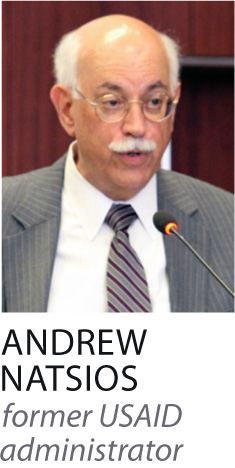
I take inspiration from former USAID Administrator Andrew Natsios’ thesis that what actually counts, is what you can’t count. In other words, if the human condition is to be elevated then that is likely to be because of power, social norms around gender, class and/or the institutions within which communities can collaborate, compete without violence or hold each other accountable through electoral politics. Not by how much you’ve spent, or what their daily income at any one point is: Natsios termed this sort of measuring the "counter-bureaucracy". 

So for me development is about advancing a process of change that all societies – that's all of ours, North and South – are constantly engaged in. This is therefore a state of freedoms, accountable institutions and rules-based systems which allow all in any one society to advance their own individual potential and secure adequate resources to live comfortably and free of fear. An example could be a schoolgirl from a marginalised minority who is able to walk to school confident of not being attacked, and widely supported to fulfil her potential. She and eventually her children thus grow: in potential, in their contribution to society and in relative economic security. This goes all the way up Maslow’s hierarchy. 

Where does diplomacy fit? 

If we take classic political science theory then International Relations are an “agora” – the Greek idea of a public space – within which states negotiate, compete and sometimes contest. Scholars often argue that there are no rules in this game: that the agora is an anarchic space with each State acting according to rational self-interest. That implies multilateral institutions or global norms are largely superficial, a means to an end with States paying lip-service when it suits. I don’t accept this notion fully, and believe here that most demonstrably democratic States are sufficiently sophisticated to mean that policy makers are minded to make the world a better place, as much as pursue their national self-interest. The two are often the same. Examples here are the human rights campaigners of the 1970s evolving into the political leaders of the 1980s & 90s and who delivered much of the human rights agendas that even authoritarian States seek to associate themselves with today. 

Plaza de Mayo demonstration about the 'disappeared': Argentina, 1982

So how do we do it? 

We learn from each other. Here are three challenges which are based on some core lessons, some of which are hard to hear depending on which side of the fence you traditionally sit.
  • Change takes time. The World Development Report of 2011 told us that societies emerging from conflict (which is where most poverty and pestilence are to be found) take an average of 30 years to break this cycle. That is well beyond what are often short-term horizons involved in foreign policy making.
  • Silos are bad. The development sector as a whole is fragmented, specialised and often works at cross purposes. That is largely down to the way in which donors fund it; but it is also reflected within donor agencies themselves. Foreign policy specialists illustrate that to achieve big things you need to work across multiple complex issue areas in a way which allows you to combine your advantages to good effect. The more successful COPs are examples of this. Development professionals need to become much better at doing the same: so the challenge to a new Department like FCDO is how do we support colleagues to develop and apply new combined skillsets? 
  • Incentives matter. This is an internal as well as an external point. Within a merged donor agency or Department, we need to ensure individuals can become professionals across traditional areas of both spheres. But incentives apply externally too. We need to recognise the hard truth that development programmes; either bilateral or multilaterally, have at times created perverse incentives that have worsened the circumstances of vulnerable populations, not enhanced them. Examples here are of structural adjustment programmes which often meant elites in Governments became more accountable to international creditors than they did to their own populations. In worse cases such programmes were instrumentalised in pursuit of harmful policies, entrenching exclusion and in some cases leading to violence or war. 
So what next 

Success for me would look like foreign policy making being conducted with the application of development insights from recent decades. In turn we would see development programming being designed in a way which is cognisant of wider political dynamics and risks, including that they could be doing more harm than good. Applying this approach to all aspects of foreign and development policy might get us towards a place where we could actually crack the nut.

Saturday, 26 February 2022

Russia, Ukraine and the future


“Who is ready to fight alongside us? I don’t see anyone … everyone is afraid” said President Zelensky this week. Earlier this week he warned European leaders on a conference call that they may not see him alive again.

We are witnessing a human tragedy and a new era in international relations develop simultaneously and the outcome will shape the world for decades to come. Part of that new era will be the increasingly uncomfortable convergence of trade-offs. Climate change emissions commitments versus reliance on pipelines for Russian fossil fuels. Avoiding alliances versus existential threats. Spending on military force versus domestic priorities on health or education. 

But part of it also will be the question of how the liberal democratic parts of our world project power through civilian, not military means. Early thinkers of what became the European Union wrote of “Civilian Power Europe”, a beguiling concept of the projection of power through non military means: regulatory, normative, market-based and other means of influence. François Duchêne’s 1972 article on this painted a picture of a new form of shaping human affairs, where the use of force was largely redundant.

As we watch Russia brutally crush a free democratic and sovereign Ukraine this seems a distant concept for what may be a darker era ahead, particularly from the vantage point of Eastern Europe or other free countries across the World dominated by larger hostile neighbours. Freedom isn’t free, sadly, and our collective commitment to standing up to force with force will need to be reinforced. This will also be an immensely painful era for Russia as it enters the status of global pariah. 


It could, however, also be an era in which democratic and free States renew and develop multilateral means of protecting and projecting the alternative. Successful, vibrant and free populations often make for messy governments but over the long term are how most people want to live. And in that lies power far greater than anything a weapons manufacturer is capable of producing. East Germans could see the towers and hear the music on the other side of the wall. Ultimately they tore that wall down with their own hands as strongmen impotently looked on. Our way of life in which we celebrate diversity, exercise freedom and hold leaders to account, choosing our own governments is something to protect – against populism and the attempts to undermine it by hostile states. But it’s also our best hope of leaving this era with the boundaries of democratic freedom expanding rather than contracting. 

It's on all of us in our own ways to work towards that.

Saturday, 11 September 2021

9/11 & Hope


So we all have a story of where we were. In my case sat agog inside my office reception in Farringdon, London. Crowds outside peering in at our large screen on the wall, broadcasting what we knew even then was history. The revolution was in the end televised. “Go home” said our manager “it’ll be us next”.

I was 25. Working out what I wanted to do with my life. For much of the next two decades I spent in the peacebuilding world. Peace, it seemed to me, was what we needed. The world at large had other ideas. Or did it?

Just as much of the world’s attention is understandably focused on Afghanistan, and the story of Iraq, Syria and terror attacks; I find optimism and hope in some of what I’ve had the privilege to see in the intervening years. Of individuals capable of finding it within themselves to forgive, to reach out and to build futures with those who had themselves often actively tried to kill them.

Like Grace, in Rwanda. She’d hidden in her family’s kitchen cupboard while her family were slaughtered by the Interahamwe militia in 1994. Fifteen years on she was establishing a new business with a man from the tribe and village who’d perpetrated that killing.

Like the old woman sitting under a tree in Western Nepal, at the end of her garden. Where she’d last seen her daughter kidnapped by armed Maoists during the civil war in 2004. Five years on she was still sitting under that tree. She knew she’d never see her daughter again. But she’d become a peacemaker to whom people would come to see, mediating disputes.

Teacher John's house

Like Teacher John in Turkana, NW Kenya. A harsh, arid place racked by armed violence carried out with impunity, particularly against girls. John spoke four languages and could have lived comfortably. Instead he lived in a mud hut and invested his money in a new school building so that girls could live while they studied, so they wouldn’t be at risk by journeying to school. He and his wife must have thought of what they were sacrificing as they used hot coals at the door by night to keep out the snakes.

Or like the young women from Herat, Afghanistan, who proudly presented plans for their villages as part of a governance programme designed to build stability and service delivery. Confidently describing the lack of trust anybody felt in the programme but determined to try to build a better future for the men, women, girls and boys of that beautiful part of Afghanistan.

These are people that represent the best of humanity. Their strengths and committment are beyond what most of us posess. And if we are to move collectively on from where our world finds itself now, then we need to find and support these individuals. Who quietly work in often remote places, overcoming psychological trauma and material hardship in the hope for a better future for us all. They, I hope, are the future now. 

Thursday, 31 December 2020

Building back better: a dose of humility


Covid has been a sobering experience, revealing the frailties of our social fabric and laying waste to the most vulnerable among us. Without engaging in a counsel of despair, I think one of the lessons for us is that to overly rely on the State to guide human behaviour simply won't work. It may also be the case that the social frameworks that were in place before, are perhaps not with us any longer. And that part of our building back better in the West might involve re-learning those aspects of social control that underpin our responsibilities to each other, and the resilience to respond to crisis, from parts of the World where they remain strong.

The problem

To share an anecdotal experience. This afternoon I stood in a supermarket and observed an elderly man standing with a basket of food, waiting for a checkout. Around him bustled shop workers, many without masks, and several shouting to their colleagues. Shoppers, including a young man with no mask, brushed physically past the elderly gentleman, rolling their eyes because he was in their way. And throughout the store, while the majority were wearing masks, many repeatedly removed them and showed no inclination to engage in distancing of any kind. Earlier today an intensive care consultant described such people as having “blood on their hands”. He’d seen the inevitable result of the behaviour I’d just witnessed in the ICU wards. 

So what’s going on? Thoughtlessness or a lack of something intangible, that might otherwise have altered behaviour?

I can’t help thinking of the stories I grew up with, of stoicism and communal support withstanding the onslaught of the Blitz. The images of St Pauls’ Cathedral, of newly homeless women making tea and others were echoed by my own grandparents in their own stories from that time. But I also think of some of the communities it’s been my privilege to work among during my own lifetime. In Turkana, Nepal, Afghanistan and elsewhere where communities have run their own affairs in the absence of a strong State and done so in a manner which would make the sort of behaviour I saw in the supermarket, and that we see in beach parties and other breaches highly unlikely. These are also places where the concept of 'positive deviance' often applies - where communities themselves have developed ways of dealing with challenges by innovating their own norms; be that cultivating land or looking after the elderly. No role for the State involved, nor for that matter international donors. Just ask Amina, from Dar es Salaam. 

Building back better?

It’s fair to say that the governance challenges witnessed in the West during the last few years undermine the idea that others should simply adopt our model of managing their affairs unquestioningly. There are other models out there and no doubt their relative merits will be hotly contested. But to me, that’s only part of the picture anyway.

We in the West will also do well to consider what we might want to learn from societies who have not relied on the State at all, be that either an authoritarian or liberal version, and have managed their affairs based on behaviours that do not encourage individualism, and the lack of empathy or responsibility that can entail, and which we have witnessed a great deal of throughout this pandemic with disastrous results. These are societies who have often managed to hang together in the face of challenges way greater than Covid, including armed conflict. Building back better will in my view need to involve a large helping of humility, and a willingness to learn from others. The vulnerable old man with his shopping basket deserved a great deal more care from those around him than he received. 

Sunday, 5 April 2020

Covid-19: peace positive?


C19 will change the world, but are there positives for peace and stability that might emerge from the carnage, and how might these be supported? Here are some emerging thoughts on how this, the pre-eminent shared challenge of us all, might just unlock conflict systems that have appeared intractable for generations.

Regional cooperation 

If C19 has taught us anything, it is that closing borders doesn’t work. There is not a single country that has been protected by doing this. Accepting that fact, and the inescapable reality that what happens in our neighbours and our neighbourhoods near and far will affect us in my view changes the dial fundamentally. Populations are in my view unlikely to respond to jingoism and ‘othering’ from elites if they can see they may pay the price at huge scale. Leaders used to whipping up sentiment may find they are in fact held to account for not working together with others.

AMISOM
Resolving conflict 

If there is growing acceptance that we need to manage conflicts, to make way for collaboration on a shared pandemic, then what structures will we need? Beyond the UN perhaps the model of the African Union’s capacity to exert soft and hard pressure might be emulated within other regional structures in Asia for example. The AU’s condemnation of coups and isolation of coup leaders have in some cases resulted in change, while the African Union Mission to Somalia has involved the use of hard power. Could it be that we emerge with strengthened institutional frameworks to temper the worst excesses of power?

A new economy 


Measuring ‘development’ by economic metrics alone is bunkum. In the most fragile countries, including those ostensibly making progress, the model is frequently highly unequal with elites controlling the most successful sectors, at the expense of others. But that model itself has now been exposed, as C19 cuts off demand in the West for goods produced elsewhere. Building back will require a much wider and diverse economic base, and that will need to include a broader section of the population. This arguably presents a real opportunity to encourage a more diverse and inclusive economic model that may pay dividends in terms of peace as much as growth.

Accountability 

It is unlikely that civil society in any country will accept business as usual once this pandemic has passed. A renewed push for greater accountability, responsiveness and transparency within governance systems can be expected, and potentially encouraged. That is as true in the West as the South and East, and represents a potential moment to renegotiate social contracts between citizens and states. More accountability generally means more peaceful societies.

Taliban anti-coronavirus drive in NE Afghanistan. New form of legitimacy? (unclear how machine gun helps v Covid)
Legitimacy 

The Black Death in 14th Century England stripped the then ruling elite of their main claim to legitimacy: namely, that it was divine will. This had been clearly dis-proven, in the eyes of the people, who proceeded to revolt. It is hard to imagine that the legitimacy of force or power alone, or narratives of supremacy will survive C19 intact. Renegotiating that legitimacy, combined with greater accountability, may open the way for far-reaching change in the balance of power that could in turn yield positive and peaceful results.

What now? 

None of the above is inevitable. But then, nobody knows what happens, now. It will take decades to know, and new generations to judge. But it is also inescapable that this is a pivotal moment in human development.

Wednesday, 8 January 2020

Infinity and beyond: Governance in fragile states

Building State Capability
The eminent Building State Capability blog has a guest article by Paul von Chamier which re-appraises possibly the most important World Development Report in recent years on how change happens in conflict affected states, that of 2011. His take makes depressing reading, using as it does the basis of the game-changing WDR11 and applying an updated data-set from the last decade (quick re-cap: economic crisis, OECD downturn, Arab Spring, Syrian conflict and lots more) and re-testing the core conclusions against that data. You may recall WDR11 posited that change only happens in generational time frames for States emerging from conflict. Von Chamier’s findings echo this, but they go further. The below table applies the Bank’s World Governance Indicators and finds that in many categories of ‘positive governance’, while there are positive signs on political stability and voice/accountability for the rest FCAS are tagged as ‘infinity’: in other words at this rate they’ll never get there.


There will be lots of nodding among many of us at this, who have been pointing out for a long time that short-termist approaches to change manifested by three-year projects that seek to rapidly ‘transform’ factors that took generations in our own countries, let alone anyone else’s, will fail. However, I do also think this take on things suffers from a bit of log-frame thinking based on limited metrics, resulting in an unnecessarily bad prognosis. A counsel of despair is never the best starting point for anything. 

Von Chamier uses, in this blog, only the Bank’s governance indicators. Useful as they are, on corruption, rule of law, institutional effectiveness and so on they fail to capture what in my view is a nebulous and perhaps intangible factor but nevertheless critical, which is how human behaviour in the form of contestation and social movements (loosely defined) manifests. Note I said social movements, not civil society as such.

And while this article understandably uses data sets from the last ten years to augment the previous 20, perhaps it’s instructive to look at wider evidence stemming back centuries of human history and social change, which still has salience to contexts we see today. Struggles in England for the rights of citizens in the 15th century, parliament in the 17th, for the right of women to have the vote in the 19th and 20th, for equality on the part of many throughout that period and which still go on would suggest that our collective history, and thus our institutions, are shaped by how those groups pursue those agendas and how elites respond; in addition to other indicators that may portray a static picture. None of this is to dispute the core argument that change in societies scarred by conflict takes generations, nor is it to argue that things cannot go backward, but it is to say that there is an intangible human element that is often missed in this form of measurement and analysis.


So work from social scientists as far back as Charles Tilly’s on social movements in the 1970s through to more contemporary analysis by Douglas North and others, not forgetting scholars from some of the countries on our lists of FCAS in the Middle East or South Asia, would suggest that there is more to predicting rates of change; and that the answer of ‘infinity’ may therefore indicate that we haven't asked all of the right questions. 

For external actors this may have implications that also echo those reached in WDR11; the import of contributing to initial political stability, creating space for human security and over the long-term peacebuilding and statebuilding in parallel to build on the one indicator that does shine out in the governance dataset: voice and accountability; which in the story of human progress could possibly the most important metric of all.

To infinity or beyond? 

Monday, 23 December 2019

Peace in the Triple Nexus: a response

Development Initiatives have produced a thought-provoking blog on “the Nexus”; which sounds like an exciting new film for Christmas, but is instead a reference to the triple nexus idea of humanitarian, development and peace (HDP) programming; and the challenges of bridging what are sometimes contradictory strands together across institutional, disciplinary and political divides.

While their main conclusion is that peace funding needs to be scaled up in order for coherent HDP programming to be realised, I thought the article also risked repeating some of the conceptual barriers that still seem to bedevil the chances of achieving that coherence. So in an attempt to add some constructive criticism here are some thoughts.

The problem here, for me, is how peacebuilding itself is conceptualised. Here are the authors:
“HDP programmes tend to work from different departure points. For humanitarians this can broadly be characterised as saving lives; for peacebuilding, as stability and security; and for development as opportunities for addressing poverty”. 
Peacebuilding is not about stability and security; it is about a long term and inevitably convoluted, contested and complex journey towards establishing the basis by which conflict can be managed without recourse to violence. This will frequently include aspects of how resources and wealth are distributed, the extent to which economic growth is inclusive, and to which institutions are effective but also perceived as legitimate and, ultimately, how contestation can be carried out through peaceful means. And while stabilisation is very much an essential part of breaking what are often cyclical conflict systems, complete with their own political economies, you can’t divorce your initial response from the longer-term factors likely to impact on the potential for longer term peace. There are dilemmas and trade-offs throughout, which span the three HDP strands. Therefore locking ourselves conceptually into a “peace = security/stability” box undermines the real extent to which HDP is ever possible. Because *all* not only *some* programming is political.

This article implies essentially that of the three strands, only peace programming is political. The authors state:
“Peacebuilding in most of its forms is a political enterprise” 
They also, in reference to OECD DAC’s ‘3 Cs – Collaboration, Coherence, Complementarity – state:
“They could be viewed as a spectrum with the humanitarian-peace nexus at the lower end with a minimum expectation of complementarity; the development-peace nexus in the middle; and the more established and less contentious humanitarian-development nexus at the higher end between collaboration and coherence”. 
Taken together this is depressing stuff. The idea that humanitarian work is not political or is somehow less contentious is surely not borne out by experience on the ground. Injecting what are often huge amounts of resources into a situation that has frequently arisen out of violent conflict, and is thus charecterised by competing groups, will always be intensely political. It will and does create winners and losers. It will and does run the risk of becoming instrumentalised by elites, both from among the target population or their surrounding host communities or governments.

But the really depressing point for me here is about expectations: relegating the humanitarian-peace nexus to the ‘lower end’ with “…a minimum expectation of complementarity” (and presumably not therefore much in the way of coherence or collaboration) is likely to make those risks more, not less likely.

The authors do however highlight some of the learning that has emerged on Nexus programming elsewhere; including the importance of factoring in analytical lenses on conflict sensitivity, the identification of peace dividends alongside immediate humanitarian need and thinking about how the design of immediate responses help or hinder long term developmental and/or peace outcomes. I would think building on those insights would require thinking that reverses the expectations outlined by our authors and makes the case for looking at all three HDP strands at each and every stage. 

Like any conversation worth having this is likely to be a difficult and challenging one, in order to get to the nub of how actors from humanitarian, developmental and peacebuilding backgrounds could and should work in a collaborative, coherent and complementary way. It’s a goal well worth aiming for, and DI deserve real credit in opening some of these questions up to debate. 

Tuesday, 3 December 2019

Innovative finance, conflict, ... and peace?


Can private finance unlock potential to help break cycles of conflict and build durable stability and peace? Pertinent questions posed in a thought-provoking article from Donata Garrasi from the Office of the UN’s Special Representative to the Great Lakes; and someone I had the great pleasure of working with during her time as the Coordinator of the International Dialogue on Peacebuilding & Statebuilding.

The article highlights some recent scholarship from Georgia Keohane, Capital and the Common Good, and argues persuasively that if we were able to create and sustain FDI flows into the markets of fragile states in the form of social impact investments, supported by a screening process to ensure conflict sensitivity and human rights principles were not compromised, together with a knowledge platform to capture learning as we go; then this would represent a chance to generate both economic and peace dividends.

It’s a compelling prospect and it’s fair to say dogmatic arguments about private investment not being part of the development space are now largely in the past. Donors are rightly looking at innovative ways in which these public private partnerships could or should work and there have been strong proponents on both sides of the fence; Paul Polman arguably having been one of the more prominent business voices in recent times.

And yet. My main challenge to the thinking in this article is that it is so clearly written from the vantage point of the pinnacle of the UN system. For example, the Bretton Woods institutions’ creation at the end of WWII are cited thus:
“The intent was to use financial institutions to further economic development and prosperity and create global stability – the ultimate public good. In other words: economic development for stability; just what is needed today”. 
This is true to an extent. But the institutions were also designed to seal the new power dynamics that had emerged in the West following the conflict, as the world emerged from the colonial era into the new bi-polar world that would assume the contours of the Cold War soon afterwards.

The article cites the need for a ‘knowledge platform’:
“…that would bring together investors with a multi-disciplinary community of practice dedicated to enhancing investment in fragile countries”. 
It suggests the World Economic Forum or the OECD as hosts, and calls for visionary leaders from North and South to set the course. But we’re not short of visionary leaders, including from the South, and those who combine public and private sector spheres; such as these women from Bangladesh. Why do these platforms always have to sit in Northern institutions; be they set amid snow-topped Swiss mountains or Parisian boulevards? 


I listened to a fascinating podcast this morning, which focused on political settlements and why some peace deals fail or falter. Both Jonathan Cohen, of Conciliation Resources, and Jan Egeland, S-G of the Norwegian Refugee Council and longstanding architect and supporter of peace accords over 20 years, spoke powerfully about the gritty, grainy realities of why some fighters return to the gun. What united their perspectives was what happens when young men and women who have demobilised, taken the first tentative steps out of fighting, find that they have nothing to transition meaningfully towards, whether that is employment, a role with dignity or both. 

There's also a distinct absence in the article of any reference to the governance challenges likely to dominate any post-conflict environment. Endemic corruption, rampant elite capture and the routine use of violence as a means of sustaining access to resources are not issues that can be 'screened' for and dealt with easily, particularly if there are investments at stake. The level of trust this engenders was to me captured by visceral comments made to me by civil society activists in Liberia almost 7 years to the day, as they sought to support their own growth into long term peace through the New Deal. This is perhaps why investments of a less scrupulous nature are also a long standing feature of these environments.

As both Jonathan and Jan noted there are examples where economic growth has played an important and positive role, in providing alternatives for former combatants, marginalised groups and others; but this isn’t the uniform experience. Grounding conversations in how to generate economic growth that supports long -term peace to me means locating those conversations in those environments, where they can draw on the reality of the contexts being discussed. And with each of them being unique in their own right, it’s likely uniform approaches of the type normally associated with discussions emerging from the high peaks of finance are unlikely to have the traction they would need to succeed.

Clear-eyed conversations, grounded in gritty realities but with the ambition Donata rightly outlines for harnessing the power of growth – now there’s a winning investment..

Wednesday, 4 September 2019

Peter da Costa: Teacher, mentor, visionary and friend


This morning I had the sad privilege of attending the memorial of Peter da Costa, along with some of his family and friends here in London. Taking place in the suitably grand surroundings of Methodist Central Hall in Westminster, we said goodbye to a teacher, a visionary and passionate advocate for the rise of Africa and all its people. With the word ‘all’ being the important one.

I’ve never written an obituary before, and by comparison to the heartfelt and beautiful contributions this morning it won’t compare. But many of you knew Peter as did I, as a co-conspirator, a colleague and a friend with whom we conjured up ideas and tried to find ways to bridge divides and try doing old things in new ways. For those of us trying to contribute to peace, to fairness and human progress he was in my view the sort of person humanity desperately needs more of, but of whom it has so few. Amid the sadness however, and Peter would be the first to say this, his ideas remain with us even if their progenitor does not. We can all build on them.

Peter was a man of amazing combinations. A fierce intellect, reflected in an academic record that broke new ground, combined with a deeply human, humble and empathetic approach. The happiest I ever saw Peter was when he was drawing ideas out of people who hadn’t had the chances he’d had, couldn’t articulate them in the same language, but did have the qualifications of experience and a willingness to share it.

A profound sense of pride, particularly in the younger people he worked with and whose potential he sought to bring out, particularly in the form of partners supported by the Hewlett Foundation, for whom he worked as an advisor. Yet this was often combined with a lack of tolerance for what he perceived as laziness, from whomsoever it came. I think in hindsight he couldn’t stand the idea of people not contributing what he could see they were able to, in the mission to which he was so committed.


But in that mission, which I would describe clumsily as Africa finally emerging as a continent among equals, with all of its people – women every bit as much as men – able to reach their potential, he exhibited another combination. A depth of kindness and non-judgmental empathy to those around him, together with a fierce lack of tolerance for corruption or the abuse of power, from whomsoever that emerged.

Peter understood and spoke the languages of different tribes in the development world. Technology. Political economy. Innovation. Data. Evidence. Power. Conflict & peacebuilding. That he could combine them and see new ways for them to work together was reflected in his many achievements. He broke boundaries and silos, persuaded governments, pushed through sheer stubbornness and supported initiatives that stood the test of time, such as the Africa Data Consensus. He was a revolutionary who sought to take people with him.

One of my last memories of Peter was standing in a Nairobi nightclub. Over the impossibly loud music, and thudding, floor shaking bass, Peter was trying to outline a thought on something to do with political economy. An absurd situation, and I’m afraid I moved the conversation on to football instead. He rolled his eyes, but with the familiar twitches of a wry smile. A microcosm of Peter – high expectations, a fearsome intellect, but all the while deeply human.

I thought of him earlier this week as I saw the sun come up over Hyde Park. It’s not enough to never forget Peter, he’d want more than that. Take his ideas and example forward. I know I’ll try to.


Friday, 21 December 2018

Peacebuilding: Time to think and act Human?


What is peacebuilding? That nearly all of you will give slightly (or significantly) different answers to that is part of what I perceive to be a wider problem. You could just as well ask ‘what is development’ with the same result. GDP, or rights? Jobs or voice? So in this brief thought piece I will restrict myself to a narrower question, which is one I believe needs to be addressed if we are to become more effective in understanding the causes of conflict, and acting to build long term and positive peace.

My argument here is that in the last ten years peacebuilding has largely benefited from a process of professionalisation. That’s a process we’ve witnessed among practitioners in the NGO sector, as much as in the donor agencies themselves, with cadres of professionals emerging in both. But my worry is that in that process we have erred too much on the side of analysing conflict through lenses of political science at the cost of wider perspectives, such as anthropology, in our quest to understand how and why humans behave the ways we do. And that makes us less effective.

When I first started in peacebuilding back in 2008 the wider development sector was heavily dominated by economists, and their metrics. So progress was seen in primarily economic terms and not those, say, of human rights, voice, struggles and the differentiated experiences of communities, women or marginalised groups. The economist mindset is still very much alive, and people like me regularly argue with their proponents, but we do generally have a more holistic approach now which is welcome. Yet in that process of widening the disciplines and perspectives we use, I fear the political scientist has become the new economist, largely without intending to be.

And that’s a problem, in my view, on a number of grounds. Political science offers us strong and useful methods of understanding conflict and wider society, usually through the prism of institutions. But as a discipline it is massively dominated by Northern and Western viewpoints which make assumptions which simply don’t hold in many of the societies in which they are applied. Within academia this has provoked a backlash in which writers from the global South, such as Chatterjee, and several Middle East scholars have written powerfully to illustrate just how the theories of Hobsbawm, Anderson, North and others simply don’t help us to grasp why people behave in the way they do in large parts of the world, in this case South Asia and the Middle East.

Traditional Northern political science essentially holds that powerful elites win and then retain power by seizing institutions, and then setting the rules of the game in their favour, in perpetuity. And there’s a large degree of truth in that. But it tends to dismiss the idea that humans are also emotional creatures with deep spiritual attachments to land, ideas, communities and belief systems (famously by Ben Anderson's "Imagined Communities" thesis) which in my view shape their behaviours as much as, if not more than, rebelling to take power. So when you’re trying to understand a conflict that might take an ethno-nationalist form, for example, where conflicting groups self identify by ethnicity, in my view this is as much about those human characteristics as it is about powerful elites. The point is we need to understand both, and act accordingly. A lot of Sue Unsworth's work, which shaped much of DFID's later thinking, also hinted at this, in order for the elite-community bargaining work which she held as central to success, to take place.

As we look across what is sadly a growing number of conflicts worldwide, where many take on that ethno-nationalist form, this in my view is a pressing issue for us as a sector to get right, and it lies in the analysis we use and the theories we develop on the basis of that analysis. More anthropology, more Southern based persepctives and more balance with the new dominant theme is needed. Essentially in my view we need to think more about humans as they are, and not as if they were robots, controlled principally by elites, even in their own minds and conceptions of the world around them. How we might do this, will be the subject of my next piece!

Until then, let me end by quoting Phil Vernon, a peacebuilder from whom I learned a great deal during my time at International Alert. Phil is both a peacebuilder and a poet, and this evocative peace captures a sight that will be familiar to peacebuilding practitioners across the globe:

I come each day to clean the marble plaque,

place flowers beneath Azadin’s face, and pray

he rests in peace. The eve of the attack,

he begged my blessing which I proudly gave –

a mother's leave to die.

Low sunlight bathes

the bridge, the road, the bracken-covered hills

in warmth and welcome; piebald peaks arrayed

Against the sky stand friendly guard.

War steals

our children but it spares them all the ills

of longer life, and us from saving them.

I sit in simple silence simply filled

with comfort by his being near.

She spends

her evenings at the bridge contentedly;

the sunlight dissolves gently in the sea.

Sunday, 16 September 2018

Nirmala: Nepal's wake up call for donors?


Nirmala was 13 when she was raped, murdered and left in the rice field that she walked across every day to go to school. She’d had to be stronger than her years, supporting her mother after her father left two years before. Teachers describe a bright and dedicated student who dreamed of supporting her mother and family to become independent and secure. Yet in a society where sexual violence is rampant and deep rooted practices sustain an oppressive environment for the vast majority of women Nirmala had learned she’d have to fight every step of the way. On that day in July, however, she wasn’t strong enough to fight. Her body lay in the field for at least a week before it was found. The police did nothing, literally, and there are widespread suspicions of some form of collusion.

Short-termism: a Donor disease

As gut wrenching as this story is on a human level, it should also make us angry. Many young Nepalis have been out of the streets protesting this week, and it is their fight to change their society which those of us who care about Nepal must hope they win. But it is also in my view a searing, damning indictment of much of what many donor agencies have been doing in the country for the last decade or so since the end of the civil war. And perhaps worst of all many of us have implicitly acquiesced with this, trying to squeeze peacebuilding into other sorts of projects rather than loudly making the case and challenging donors to justify their neglect of it.

So what’s been the problem? Well, a familiar yet lazy assumption that “conflict” is over; short term uncoordinated and technocratic projects; a misplaced faith in technology or data; superficial attention to gender and marginalisation, and a propensity to adopt one size fits all approaches have arguably combined to fail to meaningfully impact on a single root cause of what girls like Nirmala face every day. Such as 6 year old Puja Saha, who was violated and then desecrated. This horrific murder and the fallout over a botched, ineffective and possibly corrupt response by the police and authorities to it should lead to hard questions being asked of each donor agency: what they are doing in the country to support peace and development. And if they are not, then why not.

Residents of Bhimduttanagar in Western Nepal demand justice for Nirmala

Positive v negative peace

Nirmala’s family came from Kailalai in the West of the country. A former Maoist stronghold in the civil war, it’s where I first started work there over a decade ago. I remember the stories of forced land seizures, of hiding young men and children in the forests from forced abductions/conscription, but also of young women routinely violated, sometimes as a means of settling inter communal disputes. Two types of violence. Both very real. The old woman who sat quietly in her garden under a tree describing in a hollow voice the day her granddaughter was taken in a raid. She’d slept under the tree ever since, in the hope of hearing her return. At that time the war had only just finished and fighters with uniforms and guns no longer posed a direct threat. But the most basic understanding of peacebuilding will tell you that peace is not merely the absence of war, but the transformation of deep rooted drivers of conflict that are experienced and fester long into the future if left unaddressed, usually by the most vulnerable. Donor agencies in Nepal, however, ceased the vast majority of peacebuilding support a few short years later. War was over, they said. Time for us to move on. The vaunted truth, reconciliation and justice processes never really got off the ground.

Peacebuilders sometimes describe ‘negative’ and ‘positive’ peace. The former means that combatants with guns have gone, but some communities remain subject to violence or the threat of it, usually sustained by structural and social discrimination of various kinds. This begins to explain why the vast majority of conflicts are relapses of old. Positive peace on the other hand is when those underlying factors are being addressed in ways that allow all groups in society to feel secure, have the ability to pursue grievances through non-violent means and trust in the security, justice and governance institutions that are there to serve them equally. In Nepal, sadly, negative peace seemed to be enough for most of the donors.

Time to listen to evidence?

The future

Nepal has immense potential. Its’ history tells you that. If those of us who wish to support the country achieve that potential then it’s time to concede what the evidence from here and elsewhere tells us. Namely that peace requires long term investment: the game changing World Development Report of 2011 talked in terms of 30 years, for example. It takes generations to heal, and build trust. So donor projects with ridiculous claims of being ‘transformative’ over periods of 18 months or 2 years have got to go. They make little sense in terms of value for money, impact or basic common sense. We need to see long term programmes aimed at supporting the development of institutions capable of commanding the support of the communities they serve. Of supporting those champions within society who are challenging centuries of oppressive caste, ethnic or gender based norms that pose a direct risk to the lives of girls like Nirmala, often at great risk to themselves. And sustaining that work for as long as it takes.

If half the population is subject to routine violence or the threat of it, and marginalised communities remain under the yolk of entrenched structural and social discrimination then that is not peace. Nor, therefore, will it be stable or grow in a way that unlocks a country’s full potential, regardless of how much traditional development programming you engage in. Support for the current process of federalisation in the country, which in theory will bring governance closer to communities and thus more responsive is welcome, and great in theory. But it needs to be embedded in strong conflict analysis and long term, flexible initiatives that get to the roots of lingering violence, marginalisation and the corruption that sustains it. So let’s see less technocratic and short term isolated projects about data, technology or infrastructure and more long term and joined up engagement on what experience from elsewhere in the world (Kenya is instructive) tells us will be a contested and convoluted journey to a new dispensation of how government works, in order to avoid entrenching existing divides by default.

Nirmala was the future of Nepal. Her dreams and aspirations, together with evident ability, commitment and strength of character were ample evidence of that. Those out on the streets protesting will go back to their communities, many of them continuing to work in their own ways or as part of organised activism to change things for the better. They are the future too. 

Friday, 25 May 2018

Nepal, OGP & repeating the loops


It is said that the definition of madness is doing the same thing repeatedly and expecting a different outcome. Earlier this week I attended an event which suggested there was a very real risk of another country falling victim to what seems to be a trend of this, unless something can be done to bridge a divide between the evangelists of the open data movement and those of us working on peacebuilding and conflict transformation in volatile and contested states.

USAID Nepal hosted an event at which the US Ambassador, who is a strong supporter of anti-corruption initiatives, made very clear the US Government’s desire for Nepal to join the Open Government Partnership, (OGP). Flanked by a panel including the Information Commissioner and representatives from civil society and Government, she spoke to a room packed to the rafters with the great and the good of public and civic life in Nepal. Supported by Victoria Ayer, a Board Member of OGP, the Ambassador extolled the virtues of open data which she claimed would lead to accountability and greater prosperity.

This is, to put it mildly, ambitious. Nepal is embarking on a process of federalisation which itself is highly contested and in some places has contributed to violence. It has also just witnessed an historic union of the two Communist parties of Nepal forming a seemingly impregnable central Government with a two thirds parliamentary majority. So the Left has the strongest hold on the centre of power for generations, while a contested process of devolution of power to local government beckons.


An historic merger
 None of this was mentioned. Not even once. In a conversation about governance. The only time the feel-good factor about how open data was going to change everything for the better was punctured was when a prominent civil society activist said that in her opinion the problem wasn’t a lack of data, it was a lack of honesty. The Ambassador herself quoted SDG16, which as she stated, is about "peace, justice and governance". That would suggest we should be talking about all three of those strands in parallel, not just one aspect of one strand.

So what does all of this mean? Do we simply roll our eyes and give up? No. But we need to have a much more holistic conversation about how change actually happens, rather than getting fixated on one aspect of a wider process or thinking that membership of an elite club will lead to manna from heaven. We already know data itself doesn’t lead to accountability. It’s about how power, politics, behaviours and attitudes shape human relationships. Indeed the lessons of OGP itself would point to the danger of assuming fragile and contested states make genuine progress in the way that the Ambassador predicts. A glance at Kenya’s stalled progress, Sri Lanka’s questionable advances, the Philippines’ descent into murderous State impunity and, of all places, Afghanistan’s almost total lack of movement would suggest some humility might be in order before making such claims.


Nepal is a beautiful, ancient country of enormous potential. But it is also highly fragmented along multiple lines, much of which is a poisonous legacy of civil conflict. It can and should make progress both on stability and growth, with the result that young Nepalis no longer have to become mistreated economic migrants to the Gulf, but can realise their own and their country’s potential at home. But for that to happen will require the development of strong, responsive local and national government structures in which contestation over resources, policies and priorities can be managed within institutions that are regarded as the legitimate fulcrum of a contest of ideas, without the need for violence.

So none of this is to say that open data, within or without clubs like OGP, doesn’t have a fundamentally important role to play. It is a critical part of deliberative decision making, informed by evidence as much as ideology or patronage. But for international actors wishing to support that, the overwhelming weight of evidence from within Nepal as with other fragile and contested environments points to the need to take a much more holistic approach to bridging the gap between statebuilding and peacebuilding to have any chance whatsoever of success. So despite the enthusiasm among elites for membership of clubs, I’m afraid we still need to talk about who’s voices are still not even part of the conversation.